
How to Stop Overthinking at Night: A Mental Health Guide to Restful Sleep
By adminpsy

Introduction
For many people, nighttime is when the mind seems to become most active. During the day, work, responsibilities, conversations, and daily activities keep attention occupied. Once everything becomes quiet, thoughts that were pushed aside may suddenly feel louder.
You may replay conversations, worry about tomorrow, think about past mistakes, imagine negative outcomes, or create endless “what if” scenarios. This pattern of repetitive thinking can make it difficult to relax and fall asleep.
If you frequently find yourself wondering how to stop overthinking at night, it is important to understand that occasional overthinking is common. However, when it happens regularly and interferes with sleep, mood, concentration, or daily functioning, it may be worth addressing more seriously.
The good news is that several practical strategies can help calm an overactive mind and create better conditions for restful sleep.
What Is Overthinking at Night?
Overthinking involves repeatedly focusing on thoughts, problems, concerns, or possibilities without reaching a useful conclusion. At night, this may appear as worrying about the future, analysing the past, or repeatedly reviewing situations.
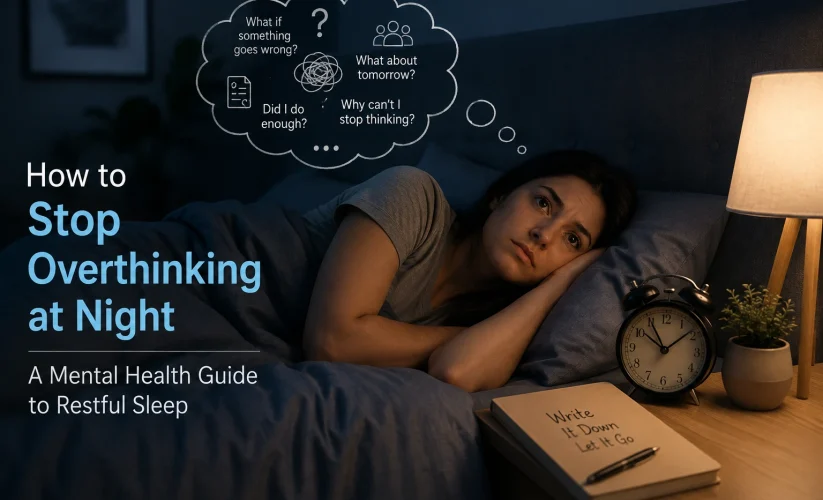
Nighttime overthinking may include thoughts such as:
- “What if something goes wrong tomorrow?”
- “Why did I say that earlier?”
- “What if I make a mistake?”
- “Could I have handled that situation differently?”
- “Why can’t I switch my mind off?”
- “What will happen if things don’t work out?”
The problem is not simply having thoughts. Everyone experiences thoughts before sleeping. The difficulty arises when the mind becomes caught in a repetitive cycle that increases emotional distress and prevents relaxation.
Why Does Overthinking Get Worse at Night?
There is no single reason why overthinking becomes more noticeable at bedtime. Several factors can contribute to it.
1. Fewer distractions
During the day, your attention may be occupied by work, studies, family responsibilities, social interactions, and other activities. At night, these distractions decrease, giving worries more mental space.
2. Stress and unresolved concerns
Unresolved problems can remain mentally active even when you physically stop working. Your brain may continue trying to analyse a situation or find a solution.
3. Anxiety
Anxiety can make the mind more alert to potential threats or negative outcomes. This can lead to repeated “what if” thoughts, particularly when there are fewer distractions.
4. Irregular sleep habits
Sleeping at different times each night, using screens late at night, or consuming caffeine too close to bedtime can make it harder to become naturally sleepy.
5. Emotional exhaustion
When you have been emotionally overwhelmed during the day, you may not have had enough time to process your feelings. These thoughts can become more noticeable when you finally lie down.
6. Mental health concerns
Persistent nighttime overthinking can sometimes occur alongside anxiety disorders, depression, chronic stress, or other mental health concerns. Overthinking by itself does not mean that someone has a mental health disorder, but persistent symptoms should not be ignored.
How to Stop Overthinking at Night
Learning how to stop overthinking at night is less about forcing yourself to “stop thinking” and more about changing your relationship with thoughts and creating a calming bedtime routine.
1. Create a “worry list” before bedtime
If your mind becomes busy with unfinished tasks or concerns, write them down before getting into bed.
Create two simple columns:
Thought or Concern | What Can I Do About It? |
Important email tomorrow | Write a draft in the morning |
Financial concern | Review the budget tomorrow |
Difficult conversation | Decide what I want to say |
Work deadline | Make a task list |
Writing concerns down can help separate nighttime thinking from problem-solving time.
The goal is not to solve every problem before sleeping. Instead, remind yourself that the concern has been recorded and can be addressed at an appropriate time.
2. Establish a consistent bedtime routine
A predictable routine helps your body and mind recognise that it is time to wind down.
Try spending the final 30–60 minutes before bed doing calming activities such as:
- Taking a warm shower
- Reading a relaxing book
- Listening to quiet music
- Practising slow breathing
- Doing gentle stretching
- Preparing for the next day
- Keeping lights relatively dim
Consistency is often more helpful than creating a complicated routine.
3. Practise slow breathing
When you notice your thoughts becoming intense, bring your attention to your breathing.
Try this simple approach:
- Sit or lie comfortably.
- Breathe in slowly through your nose.
- Allow your abdomen to expand naturally.
- Exhale slowly and comfortably.
- Repeat for several minutes.
- When thoughts appear, gently return your attention to your breathing.
The purpose is not to eliminate thoughts. Instead, breathing can provide your attention with a calmer focus.
4. Avoid fighting your thoughts
Trying to force yourself not to think can sometimes make thoughts feel even more persistent.
Instead of saying:
“I have to stop thinking about this.”
Try acknowledging the thought:
“I am having a worried thought about tomorrow. I don’t need to solve it right now.”
This approach creates some distance between you and the thought rather than treating every thought as an urgent problem.
5. Challenge unrealistic thinking
Nighttime worries can sometimes become exaggerated because tiredness and anxiety affect perspective.
Ask yourself:
- Is this a fact or a possibility?
- What evidence supports this thought?
- What evidence does not support it?
- Am I assuming the worst possible outcome?
- Would I give the same advice to a friend?
- Is there anything I can realistically do about this tonight?
These questions can help transform an emotional reaction into a more balanced perspective.
6. Keep your bedroom associated with sleep
If you spend long periods in bed worrying, scrolling through your phone, working, or watching stressful content, your brain may gradually associate the bed with wakefulness rather than sleep.
Keep the bedroom environment as comfortable and sleep-friendly as possible.
Consider:
- Keeping the room dark and comfortable
- Reducing unnecessary noise
- Maintaining a comfortable temperature
- Avoiding work in bed
- Limiting stimulating activities close to bedtime
If you cannot sleep after lying awake for a while, consider getting up briefly and doing something quiet in low light. Return to bed when you feel sleepy again.
7. Reduce late-night stimulation
Phones, social media, work emails, emotionally intense conversations, and stimulating entertainment can make it harder to mentally disengage.
Consider setting a digital wind-down period before bedtime.
Instead of repeatedly checking notifications, choose a calming activity that does not demand constant attention.
8. Be mindful of caffeine and other stimulants
Caffeine can remain in the body for several hours and may interfere with sleep in some people. If nighttime overthinking is a regular problem, consider whether coffee, tea, energy drinks, or other caffeinated products later in the day are affecting your sleep.
Individual sensitivity varies, so paying attention to timing and your own response can be useful.
9. Maintain a regular sleep schedule
Going to bed and waking up at approximately the same time each day can support a consistent sleep-wake rhythm.
Try to avoid significantly changing your sleep schedule between weekdays and weekends. A stable routine can make it easier for your body to recognise when it is time to sleep.
What to Do When Your Mind Starts Racing in Bed
When thoughts begin racing, use a simple sequence rather than trying ten different techniques at once.
Step | What to Do |
1 | Notice that your mind is overthinking |
2 | Take several slow, comfortable breaths |
3 | Identify whether the thought needs action tonight |
4 | If not, remind yourself that it can wait until tomorrow |
5 | Return your attention to breathing or another calming activity |
6 | Avoid checking the clock repeatedly |
7 | If you remain wide awake, briefly leave the bed and return when sleepy |
The objective is not perfect mental silence. The objective is to reduce the cycle of worry and create conditions that allow sleep to occur naturally.
Common Mistakes That Can Make Nighttime Overthinking Worse
Some responses to overthinking can unintentionally reinforce the problem.
Constantly checking the time
Looking at the clock repeatedly can create additional worry:
“I only have five hours left.”
“I need to fall asleep now.”
This can increase pressure and make relaxation more difficult.
Trying to solve everything at bedtime
Nighttime is rarely the best time for major decisions. If a problem does not require immediate action, write it down and revisit it during the day.
Using your phone to distract yourself
Scrolling may temporarily distract you, but stimulating content can keep your brain engaged and delay sleep.
Criticising yourself
Thinking “I shouldn’t be like this” adds another layer of distress. Overthinking is a pattern that can be worked on; it is not a personal failure.
When Is Nighttime Overthinking a Sign You Should Seek Help?
Occasional worrying before sleep is common. However, consider speaking with a mental health professional if nighttime overthinking is:
- Happening frequently
- Making it difficult to fall or stay asleep
- Affecting work, studies, or relationships
- Associated with persistent anxiety or low mood
- Causing significant daytime fatigue
- Accompanied by frequent panic or intense distress
- Becoming difficult to manage despite consistent lifestyle changes
A mental health professional can help identify what may be contributing to persistent overthinking and recommend an appropriate approach.
Can Therapy Help With Overthinking at Night?
Yes. Psychological approaches can help people understand repetitive thought patterns and develop healthier ways of responding to worry.
Depending on the underlying concern, a mental health professional may use approaches such as cognitive behavioural strategies, relaxation techniques, behavioural changes, or other appropriate psychological interventions.
For persistent sleep difficulties, cognitive behavioural therapy for insomnia (CBT-I) may also be considered. It focuses on changing behaviours and thought patterns that contribute to ongoing sleep problems.
Treatment should be individualised because nighttime overthinking can have different causes for different people.
Frequently Asked Questions (FAQs)
How do I stop overthinking at night quickly?
Try not to force your thoughts to disappear. Instead, write down the concern, practise slow breathing, acknowledge the thought without engaging with it, and shift your attention toward a calming activity. If you remain awake for an extended period, briefly leave the bed and return when you feel sleepy.
Why does my brain overthink when I try to sleep?
Nighttime provides fewer distractions, so worries and unresolved thoughts may become more noticeable. Stress, anxiety, irregular sleep schedules, and stimulating activities before bed can also contribute.
Is overthinking at night normal?
Occasional overthinking before sleep is common. However, frequent or intense nighttime overthinking that interferes with sleep or daily functioning may require professional assessment.
Does writing down thoughts help with overthinking?
Writing down concerns before bed can help organise thoughts and separate problems that need attention from thoughts that do not require immediate action. It can be particularly useful when unfinished tasks or worries keep coming back.
Can anxiety cause overthinking at night?
Yes. Anxiety can involve excessive worry and increased mental alertness, which may become more noticeable when you are trying to sleep. Persistent anxiety should be discussed with a qualified mental health professional.
Conclusion
Understanding how to stop overthinking at night starts with recognising that the goal is not to completely empty your mind. Thoughts are a normal part of being human. The more realistic goal is to reduce repetitive worry, respond to thoughts differently, and create an environment that supports relaxation and sleep.
A consistent bedtime routine, writing down worries, reducing stimulation, practising slow breathing, maintaining healthy sleep habits, and avoiding unnecessary pressure to fall asleep can all be helpful.
If nighttime overthinking is persistent, distressing, or affecting your everyday life, you do not have to manage it alone. Speaking with a qualified mental health professional can help you understand the underlying causes and identify an appropriate path forward.
Better sleep often begins with learning that every thought does not need to be solved tonight.
Contact Details:
Dr. Anjalika Atrey
Best Psychiatrist in Andheri, Mumbai
Address: Plot no. 38, Gulmohar Road, Andheri west, Juhu, Maharashtra 400049
Phone: 097605 91027
Website: thepsychiatrist.in